Target Use Case: Rapid Response / Patrol Vehicle / Home Defense.
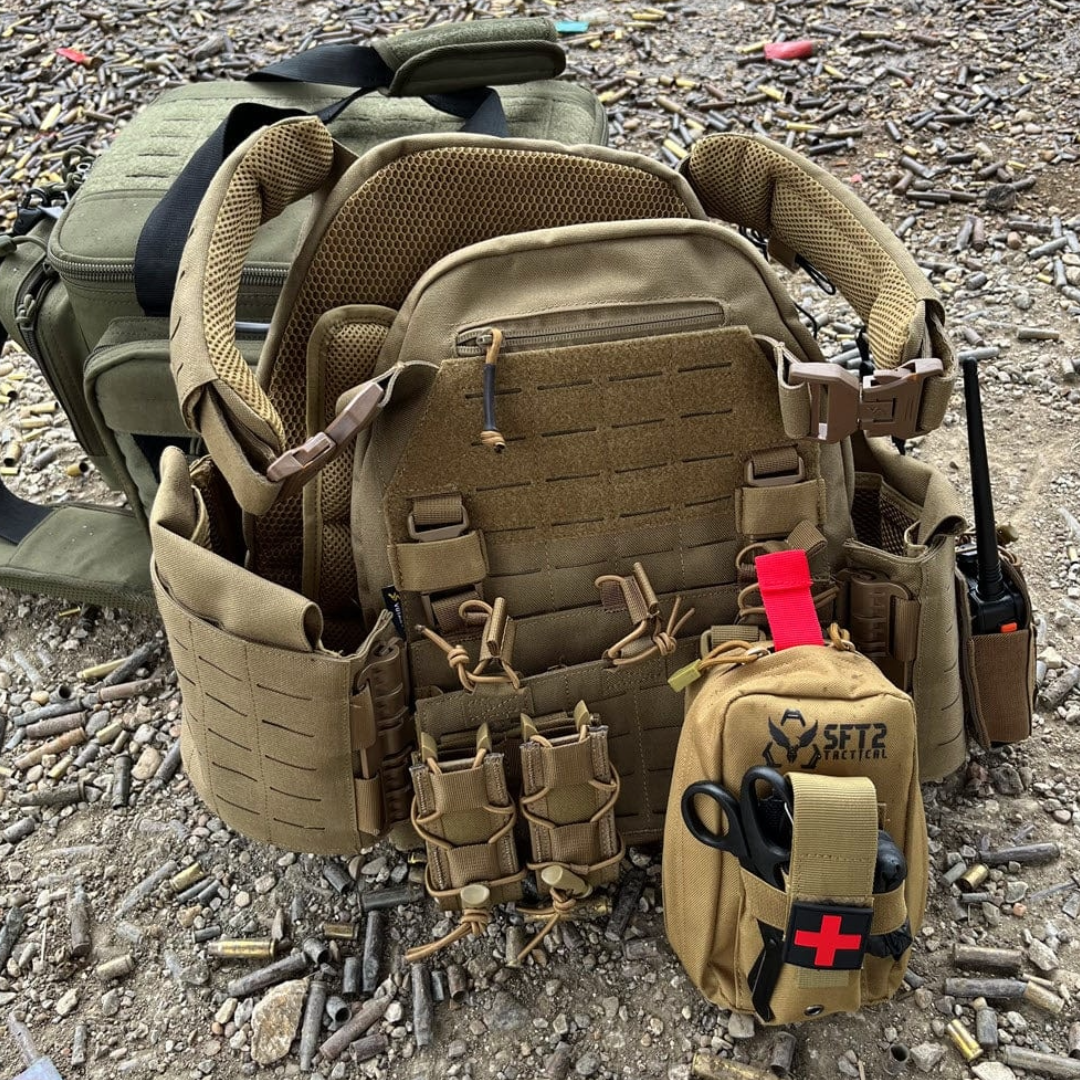
The "Who" & "What": The TX-Ranger is an entry-to-mid-level plate carrier designed for high-intensity, short-duration encounters. It requires a moderate skill level to set up correctly, but its quick-detach features make it accessible for both professional responders and trained civilians.
Pros & Cons Snapshot
Pros:
Rapid Ingress/Egress: 2" Quick-release buckles are a game changer for casualty care.
Integrated Storage: Built-in kangaroo pouch for 3 magazines + YKK admin pouch.
Cost-to-Utility: High value for the price point.
Cons:
Material Density: 1000D polyester is durable but heavier and less "breathable" than high-end 500D Cordura.
Sizing: The "One Size Fits Most" can lead to fitment issues for very petite operators.
Non-NIR Compliant: Likely to "glow" under night vision (IR), a concern for specific tactical roles.
Technical Specifications & Anatomy
When we talk about "tactical" gear, we’re talking about real estate. Every inch of this carrier must serve a purpose.
Dimensions & Weight: Designed for standard 10x12 inch SAPI/ESAPI plates (Front/Rear). It also supports 6x6 inch or 8x6 inch side plates.
Materials & Build Quality: Constructed from 1000D Polyester. While many high-end rigs use 500D Nylon for weight savings, the 1000D used here offers significant abrasion resistance—essential if you’re crawling through glass or over gravel.
Hardware: Features YKK zippers on the admin pouch. In the field, a blown zipper means lost gear.
Component Breakdown (M.A.R.C.H. Algorithm):
Massive Hemorrhage: Laser-cut MOLLE on the cummerbund allows for TQ (Tourniquet) holders at the 11 and 2 o'clock positions for ambidextrous reach.
Airway/Respiration: The front admin pouch is deep enough for a chest seal twin-pack and a 14ga decompression needle (for authorized providers).
Circulation: The kangaroo pouch can be repurposed from magazines to hold trauma dressings or IV start kits if necessary.
Hypothermia: Sufficient MOLLE on the rear to mount a hydration carrier, which can also house a space blanket.
Clinical Efficacy & Standards Compliance
From a medical perspective, the carrier itself is a delivery vehicle for armor and medical supplies.
Ballistic Support: The carrier is a "skin." Its efficacy depends on the plates you insert. SFT2 often pairs this with NIJ Level III or IV S.A.M. (Stand-Alone Multi-Hit) plates.
CoTCCC Considerations: While the carrier isn't a "medical device," its design supports TCCC (Tactical Combat Casualty Care) guidelines by allowing for rapid stripping. If I need to perform a needle thoracostomy or treat a junctional wound, I need that vest off immediately. The quick-release buckles meet this requirement.
Peer Review: This style of carrier is gaining traction among Law Enforcement "Active Shooter" kits due to the integrated mag pouches, which reduce the "gear-up" time during a hot call.
Operational Ergonomics (The "Stress Test")
In Helmand, I saw gear fail because it was too complex. Under stress, your brain reverts to "gross motor" movements.
Deployment Speed: The TX-Ranger uses 2-inch quick-release buckles on the shoulders and cummerbund. This is superior to traditional Velcro which can get fouled by mud, blood, or debris.
Fine vs. Gross Motor: The buckles are large enough to be operated with 7mil nitrile gloves or cold-weather tactical gloves.
Staging & Organization: The internal 3D mesh padding provides "stand-off" distance. This creates an air channel to mitigate heat exhaustion—a real clinical concern during prolonged engagements.
Retention: The integrated mag pouches include bungee retention. I recommend "dog-earing" the tabs (folding the tips) to ensure they can be grabbed even when your hands are slippery.
Layperson Accessibility vs. Professional Utility
The Knowledge Gap: For a layperson, this carrier is intuitive. Put it on, click the buckles. However, side plate installation can be tricky for a novice and requires ensuring the plates are centered on the mid-axillary line to protect the lungs and heart.
Instructions: SFT2 provides clear guidance, but "Just-in-Time" training is better served by the user pre-configuring their IFAK (Individual First Aid Kit) on the carrier’s side.
Liability Note/Scope of Practice: Owning a plate carrier does not grant medical authority. For my laypeople: focus on bleeding control (TQ/Pressure). Leave the advanced airway and chest decompression to the ACLS/TECC certified professionals.
Comparison & Value Analysis
The Competition: Compared to the North American Rescue M-FAK or Crye Precision JPC 2.0, the TX-Ranger is heavier but significantly more affordable. The JPC is a "minimalist" rig ($250+); the TX-Ranger is a "workhorse" rig (~$100).
Price-to-Utility Ratio: At this price point, you are getting YKK hardware and quick-release buckles that are usually found on much more expensive carriers. This leaves you more budget for what actually saves lives: High-quality Plates and CoTCCC-vetted medical components.
Final Verdict & Scoring
This is a solid "Blue Collar" plate carrier. It doesn't have the "operator" prestige of some high-end brands, but it does exactly what it says on the tin: it holds plates and stays together when things get ugly.
Durability: 8/10 (1000D is tough; stitching is reinforced at stress points).
Clinical Trust: 9/10 (High trust in the quick-release system for casualty access).
Versatility: 7/10 (Good for patrol/EDC, a bit bulky for deep concealment).
Value: 10/10 (Hard to beat the price for these features).
Overall Score: 8.50 / 10
Closing Thought: Don't buy a $500 carrier and put $100 plates in it. Buy this TX-Ranger, and use the money you saved to buy Level IV plates and a solid IFAK. Training is the only thing that doesn't have a weight limit—get out there and practice your doffing drills.
