The Role of Non-Medical Personnel
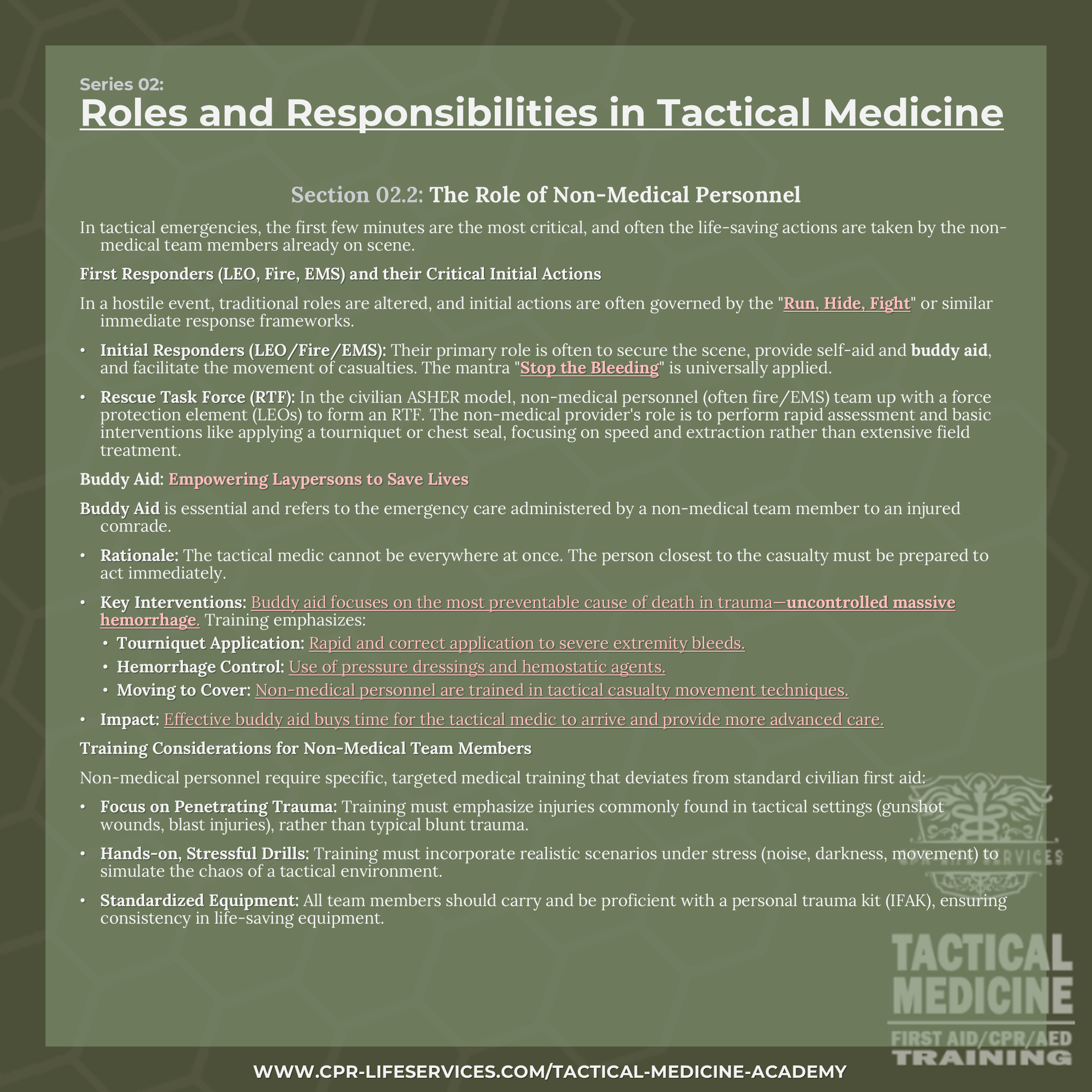
In tactical emergencies, the first few minutes are the most critical, and often the life-saving actions are taken by the non-medical team members already on scene.
First Responders (LEO, Fire, EMS) and their Critical Initial Actions
In a hostile event, traditional roles are altered, and initial actions are often governed by the "Run, Hide, Fight" or similar immediate response frameworks.
Initial Responders (LEO/Fire/EMS): Their primary role is often to secure the scene, provide self-aid and buddy aid, and facilitate the movement of casualties. The mantra "Stop the Bleeding" is universally applied.
Rescue Task Force (RTF): In the civilian ASHER model, non-medical personnel (often fire/EMS) team up with a force protection element (LEOs) to form an RTF. The non-medical provider's role is to perform rapid assessment and basic interventions like applying a tourniquet or chest seal, focusing on speed and extraction rather than extensive field treatment.
Buddy Aid: Empowering Laypersons to Save Lives
Buddy Aid is essential and refers to the emergency care administered by a non-medical team member to an injured comrade.
Rationale: The tactical medic cannot be everywhere at once. The person closest to the casualty must be prepared to act immediately.
Key Interventions: Buddy aid focuses on the most preventable cause of death in trauma—uncontrolled massive hemorrhage. Training emphasizes:
Tourniquet Application: Rapid and correct application to severe extremity bleeds.
Hemorrhage Control: Use of pressure dressings and hemostatic agents.
Moving to Cover: Non-medical personnel are trained in tactical casualty movement techniques.
Impact: Effective buddy aid buys time for the tactical medic to arrive and provide more advanced care.
Training Considerations for Non-Medical Team Members
Non-medical personnel require specific, targeted medical training that deviates from standard civilian first aid:
Focus on Penetrating Trauma: Training must emphasize injuries commonly found in tactical settings (gunshot wounds, blast injuries), rather than typical blunt trauma.
Hands-on, Stressful Drills: Training must incorporate realistic scenarios under stress (noise, darkness, movement) to simulate the chaos of a tactical environment.
Standardized Equipment: All team members should carry and be proficient with a personal trauma kit (IFAK), ensuring consistency in life-saving equipment.
Section 02.2 (Graphic)
