NAR Combat Application Tourniquet (C-A-T) Gen 7
Welcome to CPR-Life Services. I’m Brendan Tran. In my 13 years as a Navy Corpsman, deploying with the Marines and managing emergency responses, I've seen firsthand what happens when life-saving equipment is put to the ultimate test. When we evaluate gear here, we do it with a strict, unyielding 7-part review structure. We evaluate gear through both a clinical and an operational lens, ensuring it performs when your heart rate spikes and the stakes are at their highest.
Today, we are looking at the absolute gold standard in prehospital hemorrhage control: the North American Rescue (NAR) Combat Application Tourniquet (C-A-T), Generation 7.
Here is the CPR-Life Services operational debrief.
Part 1: Summary & "The Bottom Line"
The NAR C-A-T is a true force multiplier. Designed for the rapid occlusion of arterial blood flow in an extremity, this tourniquet is built for everyone—from prehospital professionals and tactical operators to the trained layperson prioritizing their family’s safety. If you carry a trauma kit, this needs to be in it.
The Bottom Line: The Gen 7 C-A-T is the most proven, widely issued, and reliable tourniquet on the market today. It is the benchmark against which all other hemorrhage control devices are measured.
Pros & Cons Table:
Pros:
· Proven Track Record: Overwhelmingly documented success in global combat and civilian trauma.
· One-Handed Application: The Gen 7 single-routing buckle makes self-application highly intuitive.
· CoTCCC Recommended: Meets the absolute highest standard of care for tactical medicine.
Cons:
· Counterfeit Risk: The most counterfeited medical device on the market; buying from unverified vendors is a fatal risk.
· Bulk: Slightly bulkier to pack flat in concealed carry medical kits compared to some competitors (like the SOF-T).
· UV Degradation: Extended, direct exposure to sunlight over years can degrade the nylon if staged improperly on external gear.
Part 2: Technical Specifications & Anatomy
Let’s look at the physical realities of the equipment.
Dimensions (Packaged): 6.5" L x 2.4" W x 1.5" D
Weight: 2.7 oz
Materials: High-strength nylon, reinforced polymer windlass rod, and stabilization plate.
When we map this to the M.A.R.C.H. algorithm, the C-A-T sits squarely at the absolute front of the line: "M" - Massive Hemorrhage.
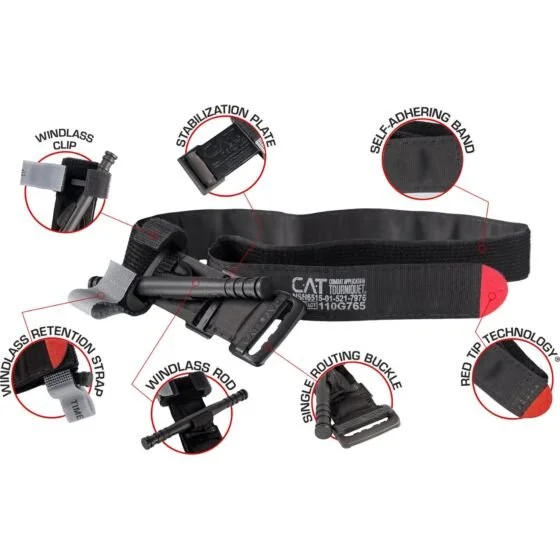
The anatomy of the Gen 7 is brilliant in its simplicity. It features a single-routing friction buckle, which eliminates the need to thread the strap through two slots (a major friction point in older generations). It utilizes a thick, reinforced polymer windlass rod to apply circumferential pressure, a windlass clip to lock the rod in place, and a highly visible white windlass strap (Time band) to secure the assembly and record the time of application.
Part 3: Clinical Efficacy & Standards Compliance
We have zero tolerance for "rogue" medicine. The C-A-T is the definition of the standard of care.
It has been recommended by the CoTCCC (Committee on Tactical Combat Casualty Care) since 2005. Its clinical efficacy is backed by decades of peer-reviewed data and agency issuance across the U.S. Military, federal law enforcement, and civilian EMS systems worldwide. When applied correctly, it achieves 100% occlusion of arterial blood flow. It is FDA-approved and heavily regulated.
A critical warning: Because of its clinical trust, the market is flooded with cheap, dangerous counterfeits. Only purchase directly from North American Rescue or authorized, vetted medical distributors.
Part 4: Operational Ergonomics ("The Stress Test")
How does this gear function when your fine motor skills degrade at 160 BPM?
The Gen 7 shines under stress. The shift to the single-routing buckle was a massive operational upgrade. Under extreme distress, feeding a nylon strap through a double-slotted buckle with blood-slicked hands is incredibly difficult. The Gen 7 allows for rapid, gross-motor manipulation. You pull the strap tight, turn the windlass until the bleeding stops, lock it into the C-clip, and secure the time strap.
However, operational ergonomics depend heavily on staging. A C-A-T left in its original plastic packaging is useless in a crisis. It must be un-packaged, properly staged, and accessible by either hand.
Part 5: Layperson Accessibility vs. Professional Utility
A medical device is only as effective as the hands deploying it.
Professional Utility: For EMTs, Paramedics, and tactical professionals, this is standard issue. The utility is absolute.
Layperson Accessibility: The C-A-T is incredibly accessible to the layperson, but we must address the knowledge gap. While the included instructions are clear, reading a pamphlet during an arterial bleed is not a strategy. Laypersons must seek out hands-on, evidence-based training—such as a Stop the Bleed course—to build the muscle memory required for effective deployment. The barrier to entry is low, but the requirement for practice is non-negotiable.
· Liability Note: If you are a civilian, operating outside your Scope of Practice (e.g., performing an invasive needle decompression as an uncertified civilian) exposes you to immense criminal and civil liability. Good Samaritan laws will not protect you if you perform an ALS intervention without a license.
Part 6: Comparison & Value Analysis
Priced generally between $30 and $35, the price-to-utility ratio is off the charts. You are paying for a device with a near-100% success rate at saving human lives.
When lined up against direct market competition, its primary rival is the TacMed SOF-T Tourniquet. The SOF-T features metal hardware and packs slightly flatter, which some executive protection or concealed-carry users prefer. However, the C-A-T’s velcro adhering system and polymer windlass generally allow for a slightly faster one-handed self-application for the average user. There are zero "filler" components here; every stitch serves a clinical purpose.
Part 7: Final Verdict & Scoring
Following our weighted scoring system, here is how the NAR C-A-T (Gen 7) grades out:
Durability: 9/10 (Excellent, though prolonged UV exposure can eventually degrade the material).
Clinical Trust: 10/10 (The undisputed benchmark of CoTCCC data).
Versatility: 9/10 (Highly effective on adults, though less optimal for very small pediatric extremities).
Value: 10/10 (Unbeatable ROI for a life-saving intervention).
Final Overall Score: 9.5 / 10
Closing Thoughts:: The NAR C-A-T is an absolute necessity. Buy it from a reputable source, take it out of the plastic, learn how to stage it, and train with it until the application becomes second nature.
