Welcome to CPR-Life Services. I am Brendan Tran.
Drawing on my 13 years of active duty service as a United States Navy Hospital Corpsman and my deployments alongside the Marines in Afghanistan, I evaluate life-saving equipment through a strict clinical and operational lens. When your heart rate spikes to 160 BPM and your fine motor skills begin to degrade, your gear must act as a seamless physical extension of your medical knowledge. "Calm is contagious" in emergency medicine, and true calm comes from trusting your protocols and your equipment.
Following our strict, unyielding 7-part review structure, today we are breaking down the absolute gold standard in wound packing and hemorrhage control: QuikClot Combat Gauze (Z-Fold, Military).
Here is the CPR-Life Services operational debrief.
Part 1: Summary & "The Bottom Line"
QuikClot Combat Gauze is designed for the rapid occlusion of life-threatening arterial and venous bleeding. It is specifically targeted for junctional trauma (such as the groin, axilla, or neck) or deep penetrating wounds where a standard limb tourniquet cannot be applied. It is a critical asset for our entire demographic: prehospital professionals, tactical operators, law enforcement, and prepared laypeople.
The Bottom Line: QuikClot Combat Gauze is the undisputed champion of hemostatic dressings. By chemically accelerating the body's natural clotting cascade, it turns a catastrophic bleed into a manageable situation in a fraction of the time compared to standard compressed gauze.
Pros & Cons Table:
Pros:
Active Clotting: Impregnated with kaolin, an inorganic mineral that safely accelerates the body's natural clotting cascade.
No Exothermic Reaction: Unlike early generations of hemostatic agents, kaolin does not generate heat and will not burn the patient or the provider.
Z-Fold Packaging: The Z-fold configuration eliminates the risk of a gauze roll falling away and becoming contaminated in the dirt.
Cons:
Cost: Hovering around $40 to $45 a unit, it is significantly more expensive than standard gauze, which can be cost-prohibitive for large-scale training.
Shelf Life: It carries a rigid 5-year expiration date due to vacuum seal degradation and sterility requirements.
Not a Magic Wand: It still requires aggressive, targeted wound packing and direct, sustained pressure to be clinically effective.
Part 2: Technical Specifications & Anatomy
Let’s examine the physical realities of QuikClot Combat Gauze.
Dimensions (Packaged): 5" H x 5.5" W x 0.625" D
Gauze Dimensions: 3 inches wide x 4 yards long
Weight: 0.8 oz
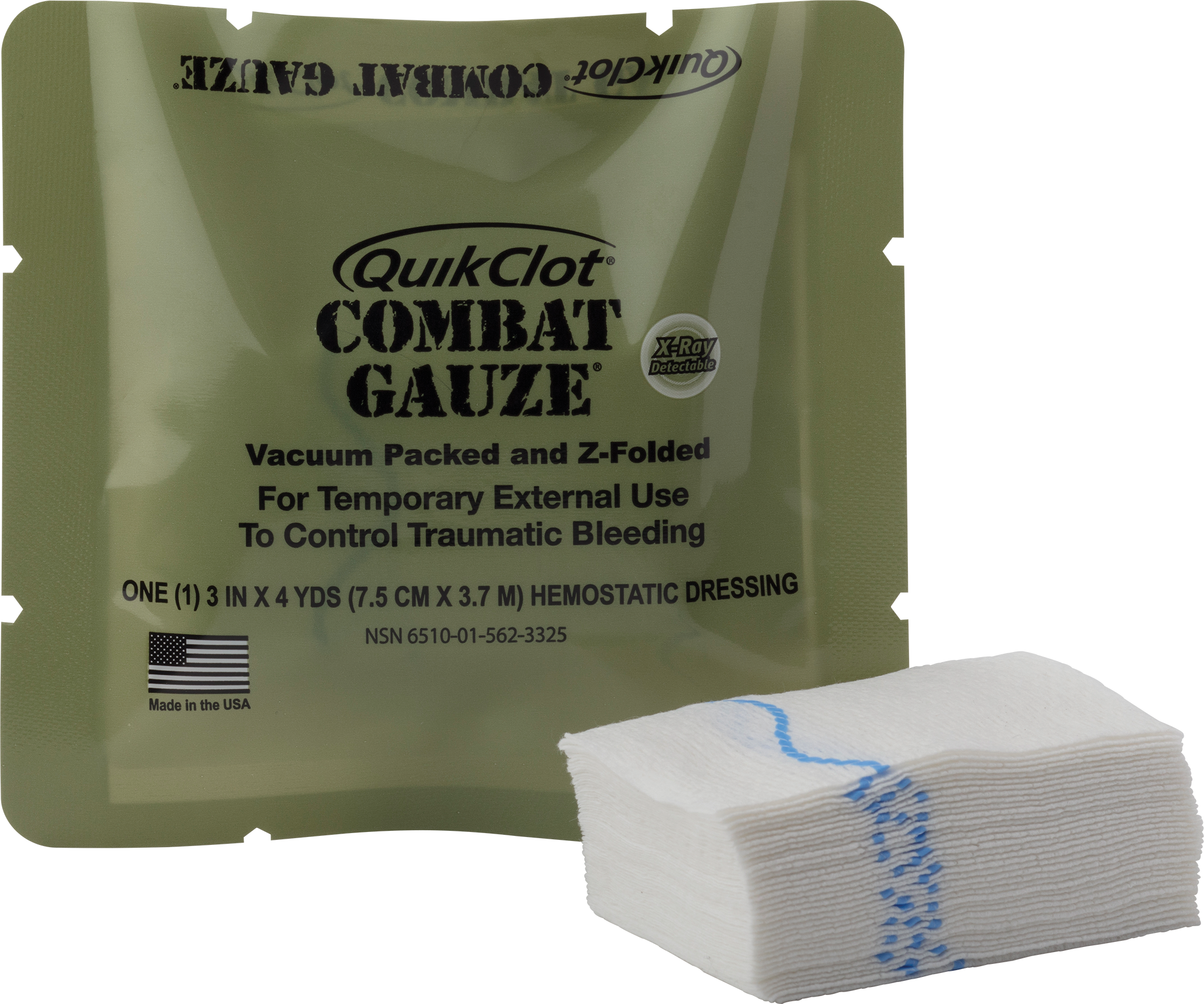
Material: Soft, white, nonwoven, hydrophilic gauze impregnated with kaolin, featuring an X-ray detectable strip for easy identification in the operating room.
When we map this device to the M.A.R.C.H. algorithm, this addresses the absolute first priority of tactical medicine: "M" - Massive Hemorrhage.
The anatomy of the dressing is brilliantly simple. The 4 yards of soft gauze are continuously Z-folded within an easy-tear, military-grade foil pouch. The inclusion of a radiopaque (X-ray detectable) strip ensures that surgeons can easily locate and remove all material once the patient reaches definitive surgical care.
Part 3: Clinical Efficacy & Standards Compliance
We have zero tolerance for "rogue" or untested medicine here at CPR-Life Services. This dressing represents the highest standard of care in modern trauma response.
QuikClot Combat Gauze is a CoTCCC (Committee on Tactical Combat Casualty Care) recommended first-line hemostatic product. Its clinical trust is immense; it is backed by years of evidence-based data, FDA approval, and massive issuance across the U.S. Department of Defense and civilian EMS systems globally. Because kaolin is an inert, inorganic mineral and not an animal or human protein, it is completely non-allergenic and safe for universal patient application.
Part 4: Operational Ergonomics ("The Stress Test")
How does this gear function under extreme psychological and physiological distress?
Let's use the "Bridge" Technique: Think of packing a deep wound like fixing a leak in a high-pressure pipe. You cannot simply throw a towel over the top of the pipe; you must jam the patching material directly into the crack to plug the source.
In a tactical environment or roadside mass casualty incident, you do not have the fine motor dexterity to chase a rolling bandage across the dirt. The Z-fold configuration is a massive operational advantage. You hold the bulk of the gauze in your non-dominant hand and continuously feed the ribbon directly to the source of the bleed with your dominant hand. Because it is hydrophilic (water-absorbing), it clings to the tissue and stays exactly where you pack it. It is engineered entirely around gross motor movements.
Part 5: Layperson Accessibility vs. Professional Utility
A medical device is only as effective as the hands deploying it.
Professional Utility: For EMTs, Paramedics, and tactical operators, wound packing with hemostatic gauze is a non-negotiable core competency. The professional utility is absolute.
Layperson Accessibility: The knowledge gap here must be addressed. A layperson often assumes they can simply lay this pad over a bleeding leg and the chemical will do the rest. That is a fatal misconception. Laypersons must seek out hands-on, evidence-based training—such as a formal Stop the Bleed course—to learn proper deep wound packing techniques. The barrier to entry is manageable, but the requirement for education is mandatory.
Liability Note: If you are a civilian, operating outside your Scope of Practice (e.g., performing an invasive needle decompression as an uncertified civilian) exposes you to immense criminal and civil liability. Good Samaritan laws will not protect you if you perform an ALS intervention without a license.
Part 6: Comparison & Value Analysis
At a price point of over $40, the initial cost shock can deter some prepared citizens. However, you are paying for an advanced chemical intervention, not just a cotton roll.
When compared to standard compressed gauze (which typically costs about $3 to $5), QuikClot buys you time—the most valuable commodity in trauma care. While you can achieve hemostasis with standard gauze and 10 minutes of direct pressure, kaolin chemically accelerates clot formation. This means you achieve occlusion much faster, freeing your hands to manage airways or assess for secondary injuries. There is absolutely zero "filler" here; every inch of this 4-yard strip serves a critical clinical function.
Part 7: Final Verdict & Scoring
Following our strict weighted scoring system, here is how QuikClot Combat Gauze (Z-Fold) grades out:
Durability: 9/10 (The vacuum packaging is exceptionally robust, though it requires strict adherence to its 5-year shelf life).
Clinical Trust: 10/10 (The undisputed CoTCCC benchmark for hemostatics).
Versatility: 9.5/10 (Critical for junctional bleeds, but highly effective in any compressible cavity).
Value: 9/10 (A premium price point, but the return on investment is a human life).
Final Overall Score: 9.4 / 10
The Verdict: QuikClot Combat Gauze is an absolute necessity for any serious trauma kit. Purchase it from an authorized vendor, ensure your kit has shears to expose the wound, and get hands-on training to understand the mechanics of deep wound packing. It is a proven force multiplier that will hold the line when it matters most.
