SAM Extremity Tourniquet (SAM-XT)
Welcome to CPR-Life Services. I am Brendan Tran.
Drawing on my 13 years of active duty service as a United States Navy Hospital Corpsman and my deployments alongside the Marines in Afghanistan, I evaluate life-saving equipment through a very specific lens. When your heart rate spikes to 160 BPM and your fine motor skills begin to degrade, your gear must act as a seamless physical extension of your medical knowledge. "Calm is contagious" in emergency medicine, and true calm comes from trusting your protocols and your equipment.
Following our strict, unyielding 7-part review structure, today we are breaking down a highly engineered solution to massive hemorrhage: the SAM XT Extremity Tourniquet.
Here is the CPR-Life Services operational debrief.
Part 1: Summary & "The Bottom Line"
The SAM XT Extremity Tourniquet is designed for the rapid occlusion of arterial blood flow in an extremity. It targets our entire demographic: prehospital professionals, tactical operators, law enforcement, and prepared laypeople. What sets this device apart is its engineering approach to the number one cause of failed tourniquet applications: user-induced slack.
The Bottom Line: The SAM XT takes the guesswork out of the initial application phase. By incorporating an auto-locking mechanical buckle, it forces the user to pull the strap sufficiently tight before they ever touch the windlass.
Pros & Cons Table:
Pros:
TRUFORCE™ Buckle: Auto-locks when the baseline circumferential force is reached, activating locking prongs that snap into the strap.
Weather-Resistant: The precision strap utilizes intervaled holes that lock mechanically, ensuring it does not rely entirely on hook-and-loop (velcro) which can fail when wet or muddy.
Rugged Construction: Features a machined 6061-T6 aluminum windlass rod and meets MIL-STD 810G testing for durability.
Cons:
Staging Bulk: Due to the robust TRUFLEX™ nylon plate and metal hardware, it is slightly bulkier and less ideal for ultra-minimalist flat-packing.
Training Nuance: Users accustomed to standard friction buckles must train to listen and feel for the distinct mechanical "click" of the locking prongs.
Part 2: Technical Specifications & Anatomy
Let’s examine the physical realities of the SAM XT.
Dimensions (Folded): 7.25" L x 2.5" W x 1.5" H
Weight: 3.8 oz
Windlass Material: Lightweight 6061-T6 aluminum
Strap Circumference Range: 5.5 inches to 35 inches
When we map this to the M.A.R.C.H. algorithm, this device addresses the absolute first priority: "M" - Massive Hemorrhage.
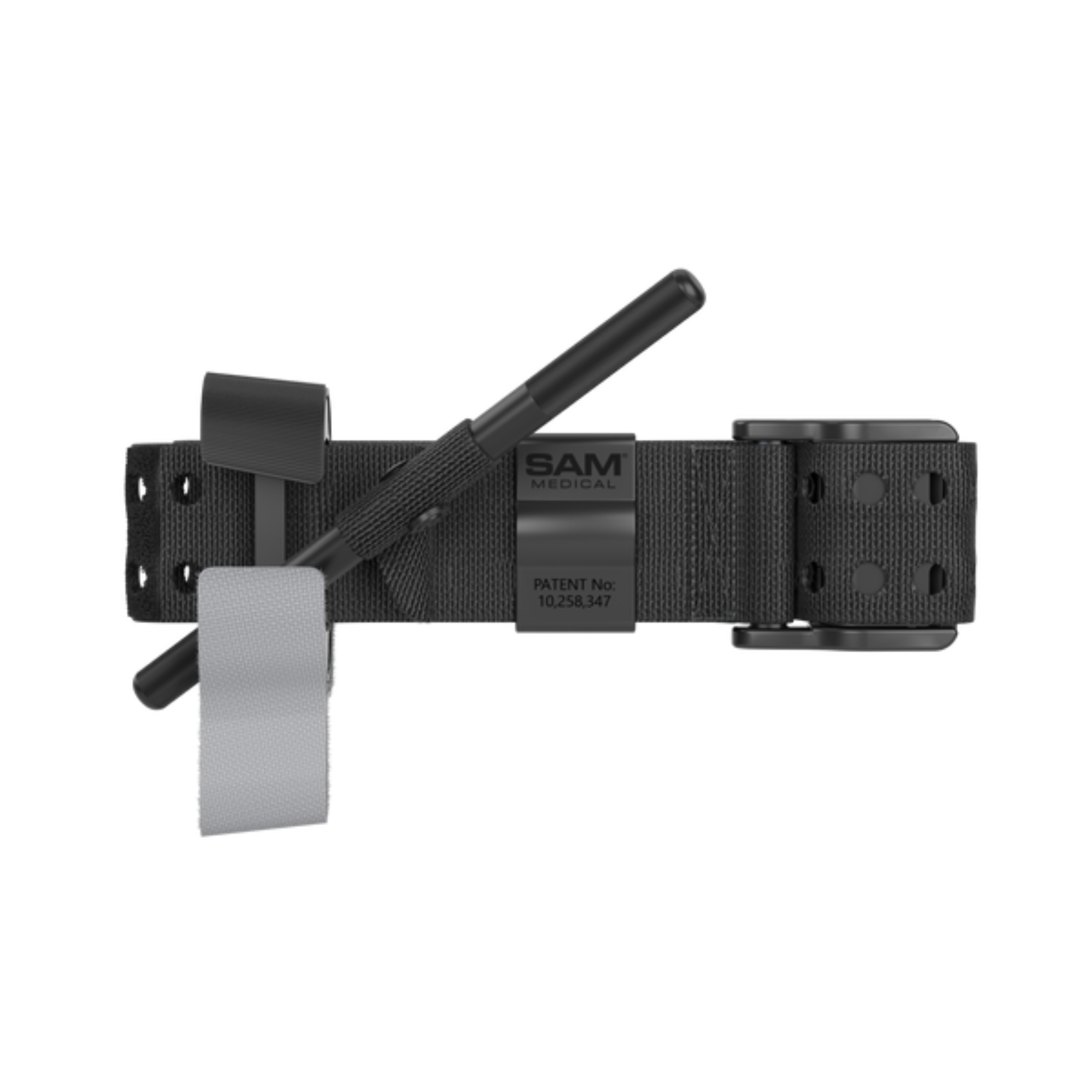
The anatomy of the SAM XT centers around the Precision Strap and the TRUFORCE™ Buckle. The single-layer nylon webbing features intervaled holes designed to interface directly with the buckle's locking prongs. The TRUFLEX™ plate distributes targeted circumferential pressure and provides a stable base for the metal rod. Once the band is tightened and the windlass rod is secured, the weather-resistant time band is applied to log the intervention.
Part 3: Clinical Efficacy & Standards Compliance
We have zero tolerance for "rogue" or untested medicine here at CPR-Life Services. The SAM XT meets the absolute highest standards for clinical trust.
This is a CoTCCC (Committee on Tactical Combat Casualty Care) recommended limb tourniquet. It is heavily vetted, rigorously tested to MIL-STD 810G standards, and backed by extensive evidence-based performance data. You are utilizing a device approved for use by the U.S. Department of Defense and professional first responders worldwide.
Part 4: Operational Ergonomics ("The Stress Test")
How does this gear perform under extreme psychological and physiological distress?
Let's use the "Bridge" Technique: Think of applying a tourniquet like tying down heavy cargo with a ratchet strap. If you don't pull the excess slack out of the webbing first, cranking the ratchet just binds up the spool without actually securing the load. In tactical medicine, failing to pull the slack out of a tourniquet means turning the windlass just twists the patient's skin without successfully occluding the artery.
The SAM XT solves this operationally. When you pull the strap tight, the TRUFORCE™ buckle measures the baseline force. Once adequate tension is reached, it automatically activates internal locking prongs that snap into the strap's interval holes. This provides an audible and tactile confirmation that all slack has been eliminated before you begin twisting the aluminum windlass. Under stress, this mechanical feedback is an incredible asset.
Part 5: Layperson Accessibility vs. Professional Utility
A medical device is only as effective as the hands deploying it.
Professional Utility: For EMTs, Paramedics, and tactical professionals operating in austere environments, the weather-resistant precision strap ensures that mud, blood, and snow will not compromise the primary security system. The secondary hook-and-loop system simply adds an extra layer of stability.
Layperson Accessibility: The barrier to entry here is arguably lower than with traditional tourniquets because the device mechanically corrects the most common layperson mistake (leaving slack). The mechanical "click" provides immediate, concrete feedback. However, a layperson must still seek out hands-on, evidence-based training—like a Stop the Bleed course—to build the requisite muscle memory.
Liability Note: If you are a civilian, operating outside your Scope of Practice (e.g., performing an invasive needle decompression as an uncertified civilian) exposes you to immense criminal and civil liability. Good Samaritan laws will not protect you if you perform an ALS intervention without a license.
Part 6: Comparison & Value Analysis
The SAM XT delivers massive utility and operates as a high-tech hybrid when compared to its primary competitors. It offers the heavy-duty aluminum windlass favored by users of the SOF-T, combined with the one-handed ease of a single-routing buckle similar to the C-A-T.
While the C-A-T remains the most widely issued device globally, the SAM XT’s auto-locking technology gives it a distinct advantage for preventing user error under duress. There are zero "filler" components on this device; every piece of hardware serves a strict clinical purpose.
Part 7: Final Verdict & Scoring
Following our strict weighted scoring system, here is the final grade for the SAM XT Extremity Tourniquet:
Durability: 9.5/10 (MIL-STD 810G tested, with a robust 6061-T6 aluminum windlass).
Clinical Trust: 10/10 (CoTCCC recommended and thoroughly evidence-based).
Versatility: 9/10 (Excellent across extreme environments, though the rigid plates make it slightly harder to conceal in civilian clothing).
Value: 9.5/10 (Premium materials and innovative mechanics at a standard life-saving price point).
Final Overall Score: 9.5 / 10
The Verdict: The SAM XT Extremity Tourniquet is a phenomenal piece of engineering that actively prevents the most common cause of application failure. Unpackage it, properly stage it, and train until you know exactly what that auto-locking mechanism feels like. It will hold the line when a life is on the line.
