Target Use Case: Patrol Vehicle (Active Shooter Response), Home Defense, and Designated Marksman/RECCE roles.
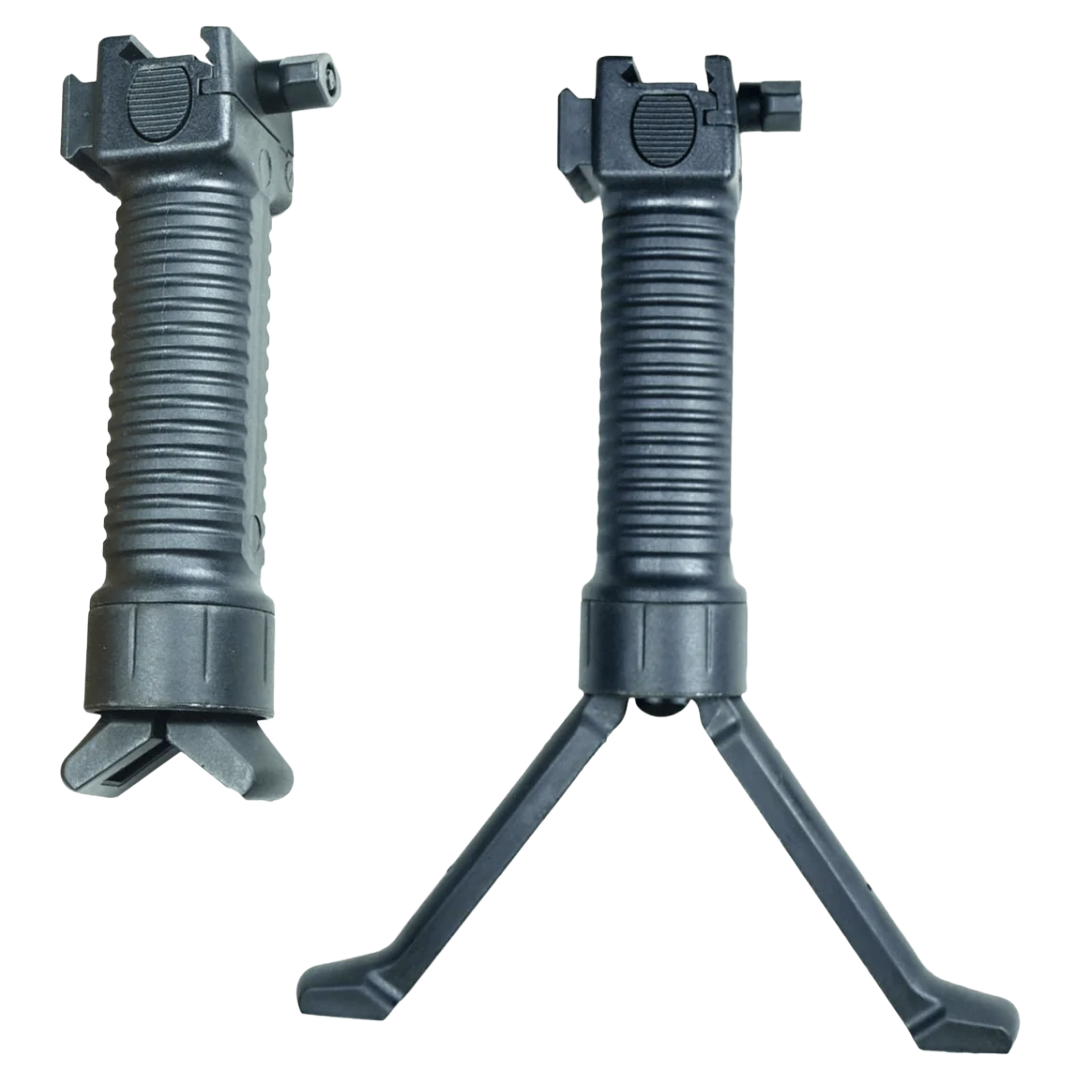
The "Who" & "What": This is a dual-purpose stabilization tool designed for modern sporting rifles or patrol carbines, combining a vertical foregrip for CQB (Close Quarters Battle) with an instant-deploy bipod for stable, long-range engagement. It is Layperson-friendly in operation but requires Professional-level recoil management and positional shooting knowledge to utilize effectively.
Pros & Cons Snapshot
Pros:
Rapid Deployment: One-button transition from grip to bipod.
Versatility: Supports both aggressive movement and static stability.
Cost-Effective: Combines two tools into one rail-space footprint.
Cons:
Bulk: Increases the vertical profile of the handguard significantly.
Mechanical Complexity: Moving parts are susceptible to grit/mud.
Ergonomics: Large diameter may be difficult for shooters with smaller hands.
Technical Specifications & Anatomy
In the tactical world, "ounces equal pounds, and pounds equal pain." However, we also have to consider "Real Estate"—how much room we have on that Picatinny rail.
Dimensions & Weight: The unit adds approximately 7-9 ounces to the front of the weapon system. While negligible in a vacuum, when added to a light, a laser, and a loaded 30-round magazine, it shifts the balance point forward.
Materials & Build Quality: Constructed from high-impact reinforced polymer with hardened steel internal springs. While not NIR (Near-Infrared) compliant in the same way high-end Berry Amendment textiles are, the matte finish provides decent light diffusion.
Component Breakdown (M.A.R.C.H. Algorithm):
The Housing: Ergonomically grooved for wet-weather retention.
The Actuator: A recessed push-button designed to prevent accidental deployment while crawling or during high-stress "white knuckle" gripping.
The Legs: Independently spring-loaded retractable feet.
Wait—how does a bipod fit into Massive Hemorrhage or Airway?
Massive Hemorrhage/Circulation: In a Tactical Emergency Medical Support (TEMS) context, the best way to stop a bleed is to stop the person causing the bleed. This tool facilitates "Suppression as Medicine." By providing a stable platform, the responder can more accurately provide cover fire, allowing a medic to move to a casualty to apply a CoTCCC-recommended tourniquet.
Clinical Efficacy & Standards Compliance
While this is not an FDA-cleared medical device, we must evaluate its "operational efficacy" through the lens of Human Factors Engineering.
Standards: There is no "CoTCCC for Bipods," but we look at Mil-Spec durability. This unit mimics the design of the Grip Pod system, which has seen extensive service with US Army and USMC units.
Evidence-Based Performance: Data from various marksmanship clinics suggests that a stabilized platform (bipod) reduces the "wobble zone" by up to 60-70% compared to off-hand shooting at distances exceeding 50 yards. In a high-stress "Tactical" event, your heart rate will be 140+ BPM. Fine motor control vanishes. A bipod compensates for the physiological tremors caused by sympathetic nervous system activation (the "Fight or Flight" dump).
Operational Ergonomics (The "Stress Test")
When the adrenaline is pumping, your hands turn into "paws."
Deployment Speed: This unit scores high. The "Tear-away" equivalent here is the one-button thumb release. It is instantaneous.
Fine vs. Gross Motor: The deployment button is large enough to be operated with 5mm neoprene cold-weather gloves or heavy-duty tactical gloves. It does not require the fine manipulation that traditional Harris-style bipods require.
Staging & Organization: In a patrol vehicle, this grip allows the rifle to be "staged" more effectively against a seat or rack, providing a secondary point of contact that prevents the rifle from sliding.
Layperson Accessibility vs. Professional Utility
The Knowledge Gap: A layperson can attach this to a rail in seconds. However, the utility gap lies in "Bipod Loading." A professional knows to lean into the bipod to create a stable "tripod" with their body. A layperson may treat it as a kickstand, which leads to "bipod jump" and missed shots.
Instructions: The product is intuitive, but I recommend users seek out "Positional Shooting" training.
Liability Note/Scope of Practice: From a medical and legal standpoint, Scope of Practice applies to your tools. If you are a civilian, using "tactical" gear does not grant you the legal protections of a Peace Officer. Your goal is always the preservation of life.
Comparison & Value Analysis
The Competition: How does it stack up against the Magpul Bipod or the Harris S-BRM?
The Harris is more stable for long-range precision but is useless as a vertical grip.
The Magpul is lighter but slower to deploy.
The SFT2 Bipod/Grip hybrid is the "Jack of all trades, master of none." It is the IFAK (Individual First Aid Kit) of rifle stabilization—it does everything well enough to save your life, even if it isn't a full surgeon's kit.
Price-to-Utility Ratio: At its current price point, it is an exceptional value. It allows a budget-conscious responder to gain two capabilities for the price of one.
Final Verdict & Scoring
After considering the clinical realities of the field—where we often have to shoot, move, and communicate while carrying a heavy medical ruck—here is my weighted score (1-10):
Durability: 7/10. It’s polymer. It will survive a drop, but it won't survive being run over by an MRAP like a steel bipod might.
Clinical Trust: 9/10. As a "stability aid," it is highly reliable. It does what it says it will do every time the button is pressed.
Versatility: 10/10. This is where the product shines. CQB in the morning, overwatch in the afternoon.
Value: 9/10. Extremely accessible for the entry-level responder.
Overall Score: 8.75 / 10
Closing Thought: In my experience, the best gear is the gear that stays on your weapon because it isn't a chore to carry. This grip/bipod combo reduces the 'faff' of extra attachments. If you’re a patrol officer or a prepared citizen, this is a solid investment in your 'Tactical Stability.' Just remember: the gear is only as good as the hand holding it. Get out there, train with it, and stay safe.
