ViTAC On-Hand First Aid Kit (OHFAK)
Target Use Case: Everyday Carry (EDC), Range Bag, Patrol Vehicle, or "Bleed-Out" kit for home defense. It is designed for the immediate "Point of Injury" (POI) response where the goal is simply to keep the blood in and the air moving until higher-echelon care arrives.
The "Who" & "What": The OHFAK is a streamlined, professional-grade trauma kit focused on the three leading causes of preventable death on the battlefield: massive hemorrhage, tension pneumothorax, and airway obstruction. While the components are professional-grade, the layout is intuitive enough for a trained layperson to use under stress.
Pros & Cons Snapshot
Pros:
Genuine, CoTCCC-recommended components (CAT TQ, QuikClot).
Compact footprint; doesn't "crowd" a belt or bag.
Rip-away design for rapid deployment/hand-off.
HSA/FSA Eligible.
Cons:
600D Polyester (standard) vs. 1000D Cordura (premium).
Limited space for additional meds or minor wound care.
600D is weather-resistant but not fully waterproof.
Technical Specifications & Anatomy
Dimensions & Weight:
Size: Approximately 8" x 6" x 4".
Weight: 1.2 lbs.
Real Estate: In the tactical world, "ounces equal pounds, and pounds equal pain." The OHFAK strikes a solid balance. It fits comfortably on a standard 1.75" duty belt or a MOLLE-compatible plate carrier without feeling like a brick.
Materials & Build Quality: The pouch is constructed from 600D Polyester. While many high-end tactical kits use 1000D Cordura, 600D is lighter and offers sufficient abrasion resistance for vehicle or bag carry. It features glove-friendly zippers and pull tabs, which is a detail often overlooked until you're trying to open a kit with slippery, blood-slicked nitrile gloves.
Component Breakdown (M.A.R.C.H. Algorithm):
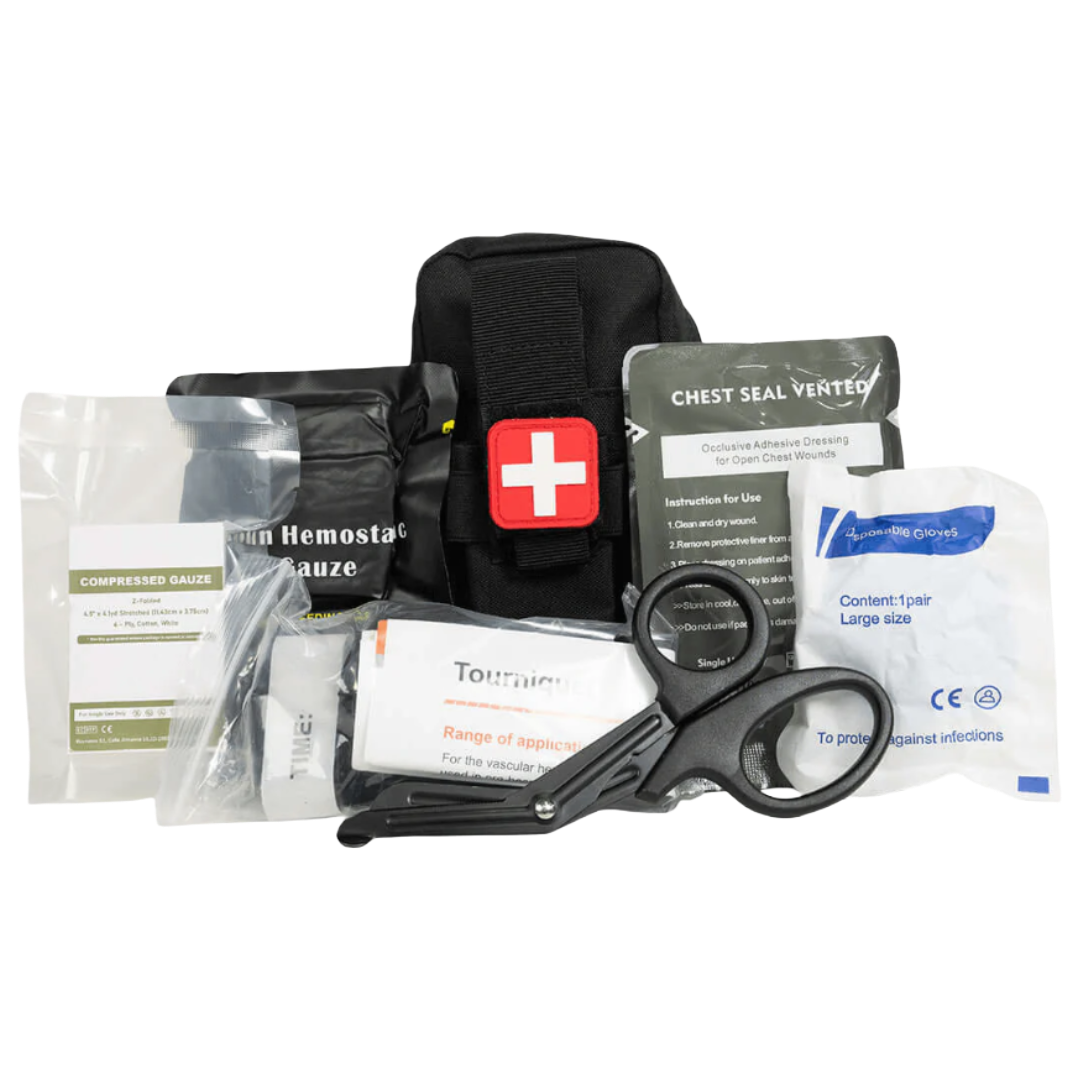
Massive Hemorrhage: CAT Gen 7 Tourniquet, QuikClot Hemostatic Gauze, Israeli Pressure Bandage.
Airway: (Note: This kit focuses on the 'R' and 'M' more heavily; standard OPA/NPA may need to be added depending on your specific loadout preference).
Respiration: HyFin Vented Chest Seals (Twin Pack).
Circulation: Compressed Gauze for wound packing.
Hypothermia/Head: Mylar Emergency Blanket.
Tools: 7.25" EMT Shears, Nitrile Gloves, Permanent Marker (for TQ time-stamping).
Clinical Efficacy & Standards Compliance
From a clinical educator's perspective, I don't care how "tactical" a kit looks if the guts are junk.
CoTCCC Compliance: The OHFAK utilizes the C-A-T Gen 7 Tourniquet, which is the gold standard recommended by the Committee on Tactical Combat Casualty Care.
Hemostatic Efficacy: It includes QuikClot hemostatic gauze (Kaolin-based). Unlike the old-school powders that caused exothermic burns, this impregnated gauze promotes clotting through the activation of Factor XII in the clotting cascade. It is evidence-based and vastly superior to standard gauze for junctional wounds (groins/axilla).
Regulatory: Components are FDA-cleared and the kit is HSA/FSA eligible, meaning it meets federal standards for medical necessity.
Operational Ergonomics (The "Stress Test")
In my time in OEF, I learned that under "the fog of war," your fine motor skills go out the window.
Deployment: The OHFAK utilizes a MOLLE-compatible rip-away panel. This is critical. If you are wearing the kit on the small of your back and need to work on yourself or hand the kit to a partner, you can tear it off the velcro base in one second.
Organization: The internal layout uses elastic retention loops. This prevents "gear vomit"—where you open the zipper and your $50 tourniquet falls into the mud. Everything stays staged.
One-Handed Use: The pull-tabs are oversized, allowing for gross-motor operation even if you're injured or wearing heavy tactical gloves.
Layperson Accessibility vs. Professional Utility
The Knowledge Gap: This kit contains a Chest Seal. For a layperson, this is a "set it and forget it" tool—highly intuitive. However, the kit stays away from "advanced-only" tools like Decompression Needles (ARS), which carry high liability for those not trained in Needle Thoracostomy.
Liability & Scope: For the EMT or Paramedic, this kit is a perfect "active shooter" response tool. For the layperson, I recommend taking a "Stop The Bleed" course. The kit is simple, but your hands need to know the rhythm of wound packing.
Comparison & Value Analysis
The Competition:
North American Rescue (NAR) M-FAK: The industry standard. The NAR M-FAK often retails for $100+.
ViTAC OHFAK: At approximately $65.00, this kit is a "disruptor." It provides the exact same high-tier clinical components (CAT TQ, QuikClot) found in kits twice the price.
Value Verdict: You are essentially paying for the components and getting the pouch for free. Many "Amazon kits" use counterfeit tourniquets that snap under pressure. ViTAC uses genuine NAR and QuikClot products, which justifies every penny of the price tag.
Final Verdict & Scoring
After evaluating the OHFAK against both civilian emergency and tactical standards, here is the clinical score:
Durability: 8/10 (600D is solid, but 1000D would be "bombproof").
Clinical Trust: 10/10 (Zero compromise on the medical components).
Versatility: 9/10 (The rip-away MOLLE panel is the hero here).
Value: 10/10 (Unbeatable price point for genuine, life-saving items).
Overall Score: 9.25 / 10
Closing Thought: If you’re a patrol officer looking for a kit that won’t break the bank, or a father looking to protect his family at the range, the OHFAK is the most cost-effective way to carry real medical gear. Don't bet your life on a $15 knock-off kit. Buy this, then go get the training to use it.
Exclusive for my students and followers: Use code “CLS10” at checkout on ViTAC’s site to get 10% OFF your entire order!
