NAR Multi-Mission Expeditionary Response Kit (MMERK)
Welcome, everyone. I’m Brendan. For those of you who haven't trained with me before, I've spent my career moving between the tactical and clinical worlds—starting as an FMF Corpsman out in Helmand Province, and later managing operations across EMS and hospital departments like Emergency Medicine and General Surgery.
Today, we are going to dive deep into a piece of serious medical infrastructure: the Multi-Mission Expeditionary Response Kit (MMERK), specifically the North American Rescue (NAR) system distributed through ViTac Solutions. We aren't looking at a basic everyday carry (EDC) pouch here. We are evaluating a deployable, multi-casualty aid station. My goal today is to give you a clinical, operational, and financial breakdown of this system so you can decide if it belongs in your unit's loadout. Let's get started.
Target Use Case: Vehicle-borne operations, maritime intercepts, rotary-wing medical platforms, extended field care, and fortified forward operating bases (FOBs) or designated mass-casualty (MASCAL) rally points.
The "Who" & "What": The MMERK is a comprehensive, professional-grade field trauma system engineered to manage multi-casualty trauma and provide prolonged field care in austere environments. This is strictly a Professional-only platform; it is designed explicitly for trained operational medics, combat lifesavers, and advanced life support (ALS) providers who are legally and clinically cleared to perform invasive, life-saving interventions.
Pros & Cons Table:
Pros:
Comprehensive Capability: True multi-casualty capacity covering all M.A.R.C.H. algorithms.
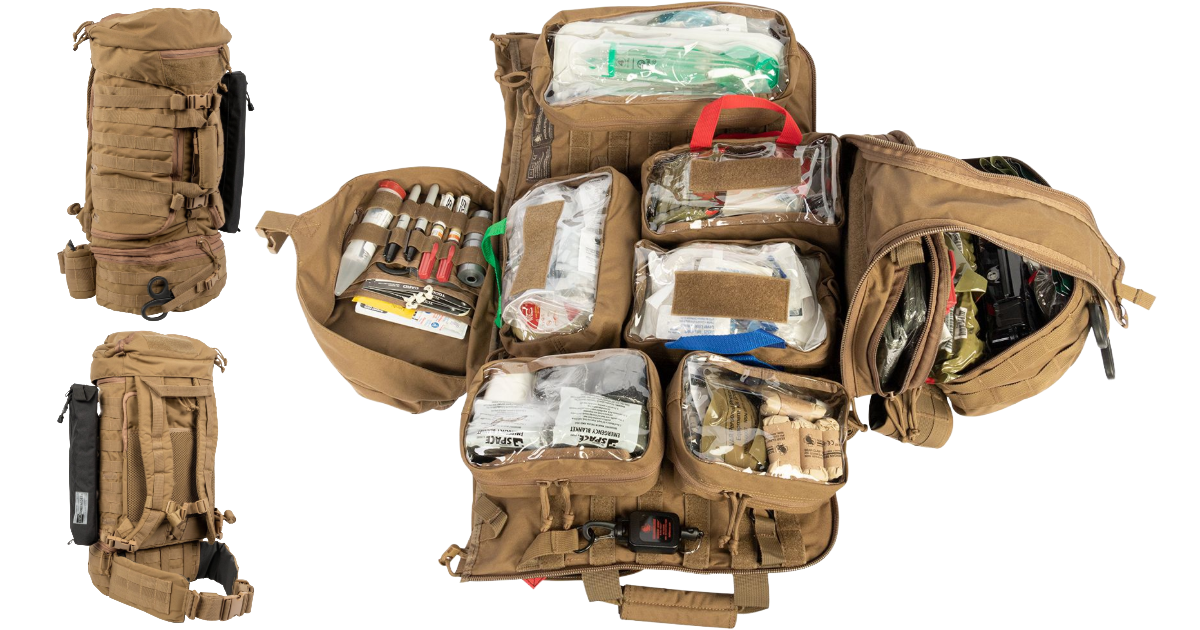
Ergonomic Deployment: Converts from a backpack to a flat trauma layout sheet seamlessly.
Modularity: 6 detachable, clear-faced vinyl pouches allow for customized, threat-specific loadouts.
Zero "Filler": Every item is clinical-grade; you won't find useless drugstore band-aids here.
Cons:
Weight Burden: At 26 lbs, it is entirely too heavy for standard dismounted light infantry patrols.
Cost: At over $4,200, this is a capital expenditure, not a casual budget item.
Scope of Practice: Highly restrictive for laypeople; filled with advanced invasive tools.
Bulk: 3,200+ cubic inches requires dedicated real estate in a vehicle or aircraft.
Technical Specifications & Anatomy
When evaluating tactical medicine gear, we look at the physical burden first, and then the clinical utility. Space on a kit is finite.
Dimensions & Weight:
Capacity: Over 3,200 cubic inches.
Weight: 26 lbs fully loaded.
Context: For context, a standard combat medic's assault aid bag sits around 12-15 lbs. At 26 lbs, the MMERK is a dedicated asset. It requires deliberate logistical planning to carry.
Materials & Build Quality:
The pack is constructed from heavy-duty, abrasion-resistant nylon (typically 1000D Cordura in NAR platforms) treated for NIR (Near-Infrared) compliance, ensuring it doesn't glow under enemy night vision. It features heavy-duty YKK zippers with paracord pulls that won't snap under tension, and reinforced rappelling loops. The interior relies on industrial-grade hook-and-loop panels that hold up against extreme temperature fluctuations and repetitive tearing.
Component Breakdown (The M.A.R.C.H. Algorithm):
Let's look at the clinical inventory using the CoTCCC standard framework.
M - Massive Hemorrhage:
Genuine Gen-7 CAT Tourniquets: The undisputed gold standard for extremity hemorrhage.
Hemostatic Agents: QuikClot Combat Gauze (kaolin-impregnated) for packing junctional wounds (groin, axilla, neck).
Emergency Trauma Dressings (ETDs): Pressure bandages for securing packed wounds and managing large lacerations.
A - Airway:
Nasopharyngeal Airways (NPAs): Sized for adult casualties, pre-lubricated to bypass the gag reflex in a semi-conscious patient.
Advanced Airway Adjuncts: Tools for securing a definitive airway when BLS methods fail (iGels or similar supraglottic airways, depending on exact unit loadout).
R - Respiration:
HyFin Vented Chest Seals: Essential for penetrating thoracic trauma to prevent tension pneumothorax.
ARS Needle Decompression Kits: 14-gauge or 10-gauge, 3.25-inch needles for bilateral needle thoracostomy.
C - Circulation:
Vascular Access: IV/IO (Intraosseous) start kits, saline locks, and administration sets for fluid resuscitation (typically whole blood or TXA in modern protocols).
Orthopedic Support: SAM Splints and cohesive wraps to stabilize pelvic and long-bone fractures, mitigating internal bleeding.
H - Hypothermia / Head Injury:
Hypothermia Prevention: Ready-Heat blankets and reflective hypothermia management kits. Trauma patients lose the ability to coagulate blood when they drop below a normal temperature—the "Lethal Triad" of trauma.
Clinical Efficacy & Standards Compliance
As medical professionals, we don't rely on marketing; we rely on data.
Certifications: The core components of the MMERK (CAT Tourniquets, Combat Gauze, HyFin Seals) are strictly CoTCCC (Committee on Tactical Combat Casualty Care) recommended. They are FDA-cleared and carry CE marks for European deployment.
Evidence-Based Performance: The hemostatic agents included operate on proven pathways. Combat Gauze utilizes kaolin to accelerate the body's natural clotting cascade, which has consistently outperformed standard gauze in porcine models and real-world combat data from OEF and OIF for junctional hemorrhage. The 3.25-inch ARS needle is specifically tailored based on autopsy data showing that standard 2-inch IV catheters consistently fail to penetrate the chest wall of muscular or overweight casualties.
Peer Review: North American Rescue platforms, and the MMERK specifically, are currently issued by the U.S. Navy Expeditionary Forces, DHS, and elite federal law enforcement tactical teams.
Operational Ergonomics (The "Stress Test")
In a firefight or a mass-casualty event, your fine motor skills degrade rapidly due to adrenaline and cortisol dumping into your system. Gear must be idiot-proof.
Deployment Speed: The MMERK excels here. It acts as a standard backpack during transport, but once on scene, it fully unzips to convert into a flat trauma sheet. You don't have to dig. You open it, and your entire clinical inventory is laid bare.
Fine Motor vs. Gross Motor: The oversize zipper pulls, and large, color-coded, clear-faced vinyl pouches allow for gross motor operation. You can operate this kit in the dark, under NVGs, while wearing thick nomex or nitrile gloves.
Staging & Organization: One of my biggest pet peeves is "gear vomit"—when you open a bag and everything falls into the mud. The MMERK prevents this through its modular hook-and-loop pouches. You can rip away the "Airway" pouch and hand it to a secondary provider while you focus on "Massive Hemorrhage," keeping the workspace uncontaminated and highly organized.
Layperson Accessibility vs. Professional Utility
I need to be very clear on this section, as I know we have preppers and survivalists in the audience.
The Knowledge Gap: This kit is not intuitive for a layperson. While anyone can be taught to apply a tourniquet or slap on a chest seal, the MMERK contains advanced tools like Needle Decompression darts and supraglottic airways. Using a 14-gauge needle to decompress a chest without understanding the anatomical landmarks (the 2nd intercostal space mid-clavicular line, or 5th intercostal anterior axillary) will kill your patient faster than the injury.
Instructions: Professional kits generally do not include "just-in-time" training manuals or QR codes. The manufacturer assumes the user has hundreds of hours of clinical and cadaver lab training.
Liability Note: If you are a civilian, operating outside your Scope of Practice (e.g., performing an invasive needle decompression as an uncertified civilian) exposes you to immense criminal and civil liability. Good Samaritan laws will not protect you if you perform an ALS intervention without a license.
Comparison & Value Analysis
At $4,209.99, the sticker shock is real. Let's analyze the value.
The Competition: When compared to standard multi-casualty kits like the standard NAR M-FAK or the TSSi M-9 Assault Medical Backpack, the MMERK is larger and designed for a stationary or vehicle-mounted footprint rather than an assault element. The M-9 is slimmer and better for a dismounted medic, but the MMERK holds significantly more volume for prolonged field care.
Price-to-Utility Ratio: Is it worth $4,200? Yes, if you are an agency. You are paying for a complete, scaled trauma system built entirely of premium, name-brand, lot-tracked components. There are no "fillers" here—no cheap tweezers, no useless knuckle band-aids to inflate the item count. You are buying a rapidly deployable emergency room. However, for an individual survivalist or a solo patrol officer, this is vast overkill. A $200-$300 IFAK covers 99% of what a single responder will face in an active shooter or vehicle accident scenario.
Final Verdict & Scoring
Let's break down the final grade.
Durability (9/10): Top-tier cordura, heavy stitching, and rugged internal vinyl. It will survive drops, drags, and rotor wash.
Clinical Trust (10/10): CoTCCC approved, strictly evidence-based. This gear is what I trusted my life and my Marines' lives to overseas.
Versatility (8/10): The ability to transition from a backpack to a trauma sheet is brilliant. It loses two points simply because the 26 lb weight makes it impossible to use as a fast-and-light patrol bag.
Value (7/10): The price is strictly agency-level. It is worth the money, but it is inaccessible to the average civilian or underfunded volunteer fire department.
Overall Score: 8.5 / 10
Closing Thoughts: The MMERK is a phenomenal piece of equipment for its intended environment. If you are outfitting a SWAT BearCat, a Coast Guard interceptor, or a remote off-grid clinical station, this is exactly what you want. But remember the golden rule of tactical medicine: Gear does not save lives. Trained providers save lives. Do not buy capability you do not have the training to employ.
Exclusive for my students and followers: Use code “CLS10” at checkout to get 10% OFF your entire order!
