Refuge Medical BikerFAK
In my time as an FMF Corpsman in Helmand and later managing clinical operations state-side, I’ve learned one absolute truth: You don’t rise to the occasion; you sink to the level of your training and the reliability of your gear. When you’re on two wheels, the margin for error is razor-thin. A high-speed slide or a collision doesn't just cause "scrapes"—it causes multi-system trauma, degloving, and femoral hemorrhages that can end a life in under three minutes.
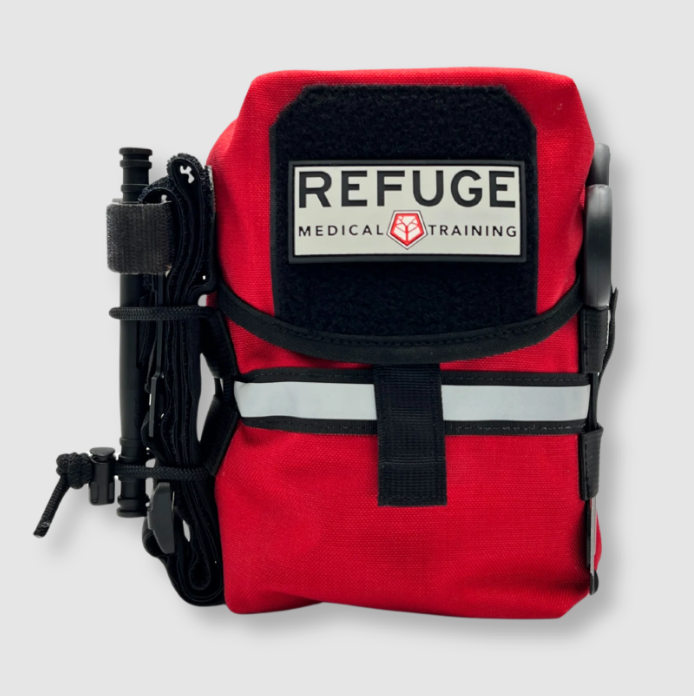
Today, we are looking at the Refuge Medical BikerFAK. This isn't just a "first aid kit" with some Band-Aids; it’s a purpose-built trauma system. Let’s break it down from a clinical and operational perspective.
Target Use Case: Primary Trauma Kit for Motorcyclists (Cruiser, Sport, or Adventure), EDC Vehicle Kit, or a streamlined Range Bag IFAK.
The "Who" & "What": The BikerFAK is a comprehensive life-saving system designed to bridge the gap between point-of-injury and EMS arrival. While the "Boo-Boo" components are layperson-friendly, the trauma core (Tourniquet, Chest Seals, ETD) requires—and deserves—dedicated training.
Pros & Cons Snapshot
Pros:
CoTCCC Grade: Includes genuine CAT Gen 7 TQ and NAR dressings.
USA Made: High-quality 500D/1000D Cordura construction.
Organization: Rapid-deploy inner pouch prevents "gear vomit."
Comprehensive: Includes burn care and "minor" injury supplies.
Cons:
Bulk: Larger footprint than some "micro" bike kits (6.5" x 9").
Price Point: High initial investment compared to DIY kits.
Non-NIR: Not specifically marketed for night-vision signature reduction.
Weight: Approx 2 lbs, which is heavy for ultra-light hikers.
Technical Specifications & Anatomy
Dimensions & Weight: Stuffed, the kit sits at approximately 6.5" x 9" x 4.5" and weighs in at 2 lbs. For a biker, this fits perfectly in a saddlebag or a sissy bar bag, but it’s too large for a jacket pocket.
Materials & Build Quality: The outer shell is ruggedized Cordura with MOLLE-compatible webbing. It utilizes a "tear-away" or "rapid-deploy" inner pouch system. In a crash scenario, your fine motor skills will be gone; you need the gross-motor "rip and go" capability this provides.
Component Breakdown (M.A.R.C.H. Categorization)
[M] Massive Hemorrhage:
CAT Gen 7 Tourniquet: The gold standard.
6" Emergency Trauma Dressing (ETD): High-pressure modular bandage.
Compressed Gauze: For wound packing junctional bleeds.
[A] Airway:
Note: Standard BikerFAK relies on positioning; however, it supports the addition of an NPA (Nasopharyngeal Airway) if the user is trained.
[R] Respiration:
Chest Seals (2pk): For treating sucking chest wounds (penetrating trauma).
[C] Circulation:
Abdominal Pads (5x9): For secondary bleeding control.
Rolled Gauze & Ace Wraps (2", 4"): For extremity stabilization and pressure.
[H] Hypothermia / Head / "Everything Else":
Burn Dressing (4x4): Essential for exhaust pipe or friction burns.
Poly Eye Shield: Critical for ocular trauma (common in open-face helmet users).
The "Boo-Boo" Suite: Steri-Strips, skin glue, antiseptic wipes, and assorted bandages.
Clinical Efficacy & Standards Compliance
From a clinical standpoint, I look for items that are evidence-based.
Certifications: The CAT Gen 7 is CoTCCC (Committee on Tactical Combat Casualty Care) recommended. This isn't a "knock-off" from a discount site that will snap under pressure.
Evidence-Based Performance: The inclusion of the North American Rescue (NAR) ETD is significant. Clinical data shows that the pressure bar design of the ETD/Israeli-style bandages provides superior focal pressure on arterial bleeds compared to standard elastic wraps.
Peer Review: The components within this kit—specifically the CAT TQ and the NAR Chest Seals—are standard issue for the US Army, FBI, and various DHS agencies. You are carrying what the pros carry.
Operational Ergonomics (The "Stress Test")
Deployment Speed: The kit uses a dual-handle deploy system. Whether you are left or right-handed, or if one arm is incapacitated in a slide, you can reach back and rip the inner tray out.
Fine vs. Gross Motor: The zippers and pull-tabs are oversized. This is critical. When your adrenaline is spiking and your heart rate is 150 BPM, you cannot fiddle with tiny zippers.
Staging & Organization: Inside, the items are secured with elastic loops. This prevents "gear vomit"—where you open the kit and everything falls into the dirt or oil on the roadside.
Layperson Accessibility vs. Professional Utility
The Knowledge Gap: The "Boo-Boo" bag is intuitive. Anyone can apply an antiseptic wipe. However, Chest Seals and Tourniquets require training. Using a TQ incorrectly can lead to unnecessary tissue damage; not using one when needed leads to death.
Instructions: Refuge Medical often includes QR codes for "just-in-time" training videos. While helpful, watching a video while your buddy is bleeding out is not a plan.
Liability Note: As an educator, I must remind you: Always act within your Scope of Practice. If you are a layperson, take a "Stop the Bleed" course before you rely on this kit.
Comparison & Value Analysis
The Competition: Compared to the NAR M-FAK, the BikerFAK is more "civilian-comprehensive." The M-FAK is strictly trauma; the BikerFAK acknowledges that on a long ride, you might just need some skin glue for a blister or a burn dressing for an engine burn.
Price-to-Utility Ratio: At roughly $200-$250, you are paying a premium for the American-made bag and the curated, non-expired, genuine components.
Scrutiny of "Filler": While the "Band-Aid Bag" feels like filler to a combat medic, for a biker on a cross-country trip, it adds legitimate value. However, the 1" medical tape is a weak point; I’d prefer to see a small roll of flat-fold duct tape or "Trauma Tape" for better adhesion in sweaty/bloody conditions.
Final Verdict & Scoring
This kit is "Brendan-approved" for the serious rider. It avoids the pitfalls of "Amazon Specials" by using life-saving components that actually work when the chips are down.
Durability: 10/10 (Overbuilt for most civilian needs).
Clinical Trust: 10/10 (No knock-off components found).
Versatility: 8/10 (A bit bulky for small sportbikes, perfect for everything else).
Value: 8.5/10 (Expensive, but the lifetime guarantee on the bag adds weight).
Overall Score: 9.1 / 10
The Bottom Line: If you ride, you are an "Immediate Responder." This kit gives you the tools to survive the "Golden Hour." Don't just buy it—get the training to use it.
Exclusive for my students and followers: Use code “CLS10” at checkout on the Refuge Medical’s site to get 10% OFF your entire order!
