VITAC TACTICAL TRAUMA BACKPACK
As a former FMF Corpsman who deployed to the Helmand Province (OEF) and later transitioned into EMS Operations and Medical Department Management, I’ve seen firsthand what works in the dirt, in the back of an ambulance, and in the trauma bay.
Today, we are looking at the ViTAC Tactical Trauma Backpack (w/ Advanced Bleeding Control & Premium Add-On). My goal here is not just to show you what is in the bag, but to explain why it matters, how it functions under stress, and who should be using it. Whether you are a seasoned paramedic, a tactical law enforcement officer, or a prepared citizen, understanding your gear is the first step in the chain of survival.
Let's dive into the clinical and operational breakdown.
Target Use Case: Active Shooter/MCI (Mass Casualty Incident) Staging, Patrol Vehicle Trunk Kit, Wilderness Search & Rescue (SAR), and Comprehensive Home Defense/Disaster Preparedness.
The "Who" & "What": This is a high-capacity, multi-patient trauma and medical backpack designed to bridge the gap between basic first aid and advanced tactical trauma care. While it features an intuitive layout accessible to a trained layperson, it contains professional-grade, specialized interventions that demand standardized clinical training to deploy effectively.
Pros & Cons Table
Pros:
CoTCCC-Approved Upgrades: Includes genuine CAT Gen 7, QuikClot, and HyFin Chest Seals in the Premium Add-On tier.
Comprehensive Scope: Covers everything from massive hemorrhage and airway management to minor boo-boos and environmental exposure.
Organization: Multiple internal compartments and MOLLE compatibility allow for logical, rapid-access staging.
Cons:
Footprint: At 18x13x13 inches, it is bulky; this is a staging or vehicle bag, not an assault pack.
Filler Gear: Contains diagnostic tools (stethoscope/BP cuff) and surgical items (scalpels/sutures) that are outside the scope of most users.
Redundancy: The base kit includes generic versions of tools (like a generic tourniquet) that are superseded by the premium add-ons.
Technical Specifications & Anatomy
Dimensions & Weight: Measuring 18" x 13" x 13", this is a substantial pack. In tactical medicine, real estate is everything. You are not mounting this to a plate carrier. This is designed as a primary medical bag to be thrown from the back of an SUV or staged at a casualty collection point (CCP).
Materials & Build Quality: Built around a rugged nylon chassis with aggressive MOLLE webbing on the exterior. This allows you to modularize the pack—attaching external IFAKs or dedicated tourniquet pouches for instant access. Zippers are robust enough to handle being overstuffed and yanked open under adrenaline.
Component Breakdown (M.A.R.C.H. Algorithm):
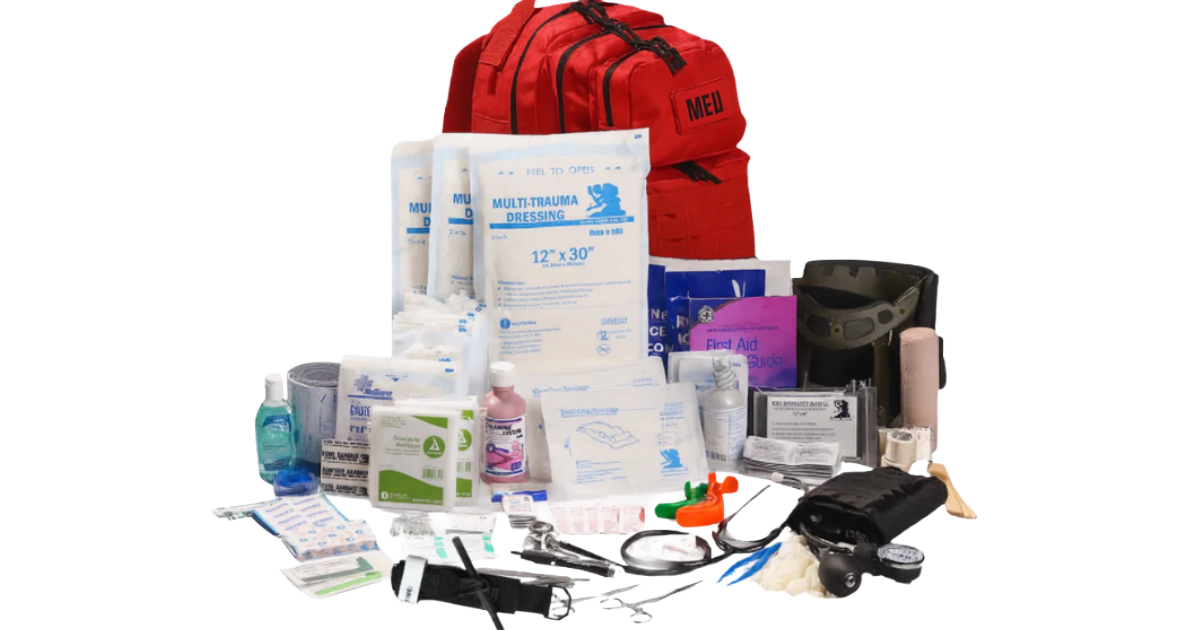
M - Massive Hemorrhage: This is what kills first. The Premium Add-On shines here. You get a genuine CAT Gen 7 Tourniquet and a 6" Israeli Pressure Dressing. For wound packing, it includes QuikClot Combat Gauze (3"x2'). The base kit also provides backup elastic bandages, trauma pads (12"x30" and 5"x9"), and an additional generic windlass tourniquet.
A - Airway: You cannot oxygenate if the pipe is clogged. The kit includes a 28 French Nasopharyngeal Airway (NPA) with lube, which is the standard adult size for securing an airway in a patient with an intact gag reflex. It also features 110mm and 80mm Oropharyngeal Airways (OPAs) for unconscious patients.
R - Respiration: To combat tension pneumothorax from penetrating chest trauma, the Premium tier includes the HyFin Vented Chest Seal Compact Twin Pack. This allows you to cover both entry and exit wounds. A CPR face shield is also provided for rescue breathing.
C - Circulation: Once the massive bleeding is stopped, we must maintain blood volume and stabilize fractures that could cause internal bleeding. The kit includes a 4"x36" padded flexible splint (similar to a SAM splint) for pelvic or long-bone stabilization, alongside extensive gauze and bandages to secure wounds.
H - Hypothermia/Head Injury: Trauma triad of death begins with hypothermia. Blood does not clot when a patient is cold. The kit includes two emergency blankets to trap radiant body heat, and a cervical collar to stabilize the C-spine following blunt force trauma.
Clinical Efficacy & Standards Compliance
As an educator, I demand evidence-based medicine. The inclusion of the Premium Add-On elevates this ViTAC bag from a basic first aid kit to a clinically sound trauma asset.
Certifications & CoTCCC Approval: The Committee on Tactical Combat Casualty Care (CoTCCC) is the governing body for battlefield medicine. The CAT Gen 7 and QuikClot Combat Gauze are CoTCCC-recommended. The HyFin Vented Chest Seals meet all current guidelines for managing open pneumothoraces.
Evidence-Based Performance: Why QuikClot? Hemorrhage control in junctional areas (groin, axilla) where tourniquets cannot be applied requires packing. QuikClot utilizes kaolin, an inorganic mineral that rapidly activates Factor XII in the blood's intrinsic coagulation pathway. Studies utilizing porcine (pig) models with lethal femoral artery transections consistently demonstrate that kaolin-impregnated gauze significantly outperforms standard gauze in achieving hemostasis and improving survivability.
Peer Review: The CAT Gen 7 is the currently issued tourniquet for the US Military, nearly all federal law enforcement agencies (FBI, DHS, ATF), and top-tier EMS systems globally. You are carrying the exact same life-saving technology as a flight medic or an infantry corpsman.
Operational Ergonomics (The "Stress Test")
Deployment Speed: When a patient is bleeding out from a femoral artery, you have roughly 3 minutes. The bag features a clamshell-style zipper design. While not a true "tear-away" IFAK, the zippers allow the main compartment to be opened fully and laid flat.
Fine Motor vs. Gross Motor: Adrenaline destroys fine motor skills. Your heart rate spikes to 150 BPM, and your fingers feel like sausages. The Gen 7 CAT is designed entirely around gross motor movement—the single routing buckle allows for rapid, one-handed application.
Staging & Organization: The backpack features multiple compartmentalized pockets.
Pro-Tip: I highly recommend taking this bag apart when you get it and reorganizing it. Keep your Massive Hemorrhage and Airway interventions in the most accessible, top-most pockets. Consolidate the "boo-boo" items (band-aids, ibuprofen, sting relief) into a secondary compartment so they don't cause "gear vomit" when you are frantically searching for a chest seal in the dark.
Layperson Accessibility vs. Professional Utility
The Knowledge Gap: This bag spans a wide spectrum. Vented chest seals and tourniquets are highly intuitive; with a basic Stop The Bleed® course, a layperson can save a life. However, inserting an NPA requires understanding contraindications (e.g., assessing for battle signs or cerebrospinal fluid indicating a basilar skull fracture).
Liability Note & Scope of Practice: We must talk about the surgical tools. This kit includes scalpels, sutures, and forceps. Unless you are an FMF Corpsman, a PA, an NP, or an MD in a grid-down survival scenario, do not use these. For EMTs, Paramedics, and laypeople, suturing and surgical cut-downs are outside your legal scope of practice. Rely on your pressure dressings and hemostatic agents.
Instructions: A basic First Aid guide is included, which is fine for minor injuries. However, in a trauma scenario, you do not have time to read. You must build muscle memory before the event.
Comparison & Value Analysis
The Competition: When we look at industry standard multi-patient bags from companies like North American Rescue (NAR) or specialized Tactical Medical Solutions jump bags, prices often start at $450 and easily exceed $700.
Price-to-Utility Ratio: At $299.97 for the Premium Add-On variant, the value here is exceptional. You are paying for the high-end CoTCCC gear (CAT, QuikClot, Israeli, HyFin), which purchased separately would cost a significant amount.
Scrutinizing the "Filler": As an operations manager, I look at weight versus yield. Does a tactical responder need a stethoscope and a manual blood pressure cuff in a hasty CCP? Usually, no. Palpating a radial pulse tells me if their systolic BP is above 80 mmHg—which is all I care about in the Golden Hour. The 44 BZK wipes, ammonia inhalants, and dozens of tiny band-aids add bulk. However, for a Prepper or a Family Home Kit, these minor items provide excellent day-to-day utility, ensuring you don't have to buy a second "boo-boo" kit.
Final Verdict & Scoring
This kit represents a highly capable, scalable medical platform. ViTAC Solutions has done an excellent job providing a base pack that covers minor emergencies, while smartly offering the "Premium Add-On" to satisfy the rigorous demands of tactical medicine professionals.
Durability: 8/10. The bag is tough and will survive the trunk of a squad car or the back of an ATV for years.
Clinical Trust: 9/10 (With the Premium Add-On). The inclusion of genuine, name-brand CoTCCC interventions means I would trust this gear on my own family.
Versatility: 8/10. It is a bit too large to be an assault pack, but perfectly sized for a vehicle, home, or staging area.
Value: 9/10. At under $300 for a fully stocked bag with top-tier hemostatics and tourniquets, it punches well above its weight class.
Overall Score: 8.5 / 10
My final advice: Buying the gear is only 10% of the equation. The other 90% is training. Get this bag, open it, learn every single pocket, and take a certified Stop The Bleed, TECC, or First Aid course. If you have any questions regarding how to stage this kit or the clinical application of its contents, please reach out. Stay safe, and stay ready.
Exclusive for my students and followers: Use code “CLS10” at checkout on ViTAC’s site to get 10% OFF your entire order!
